





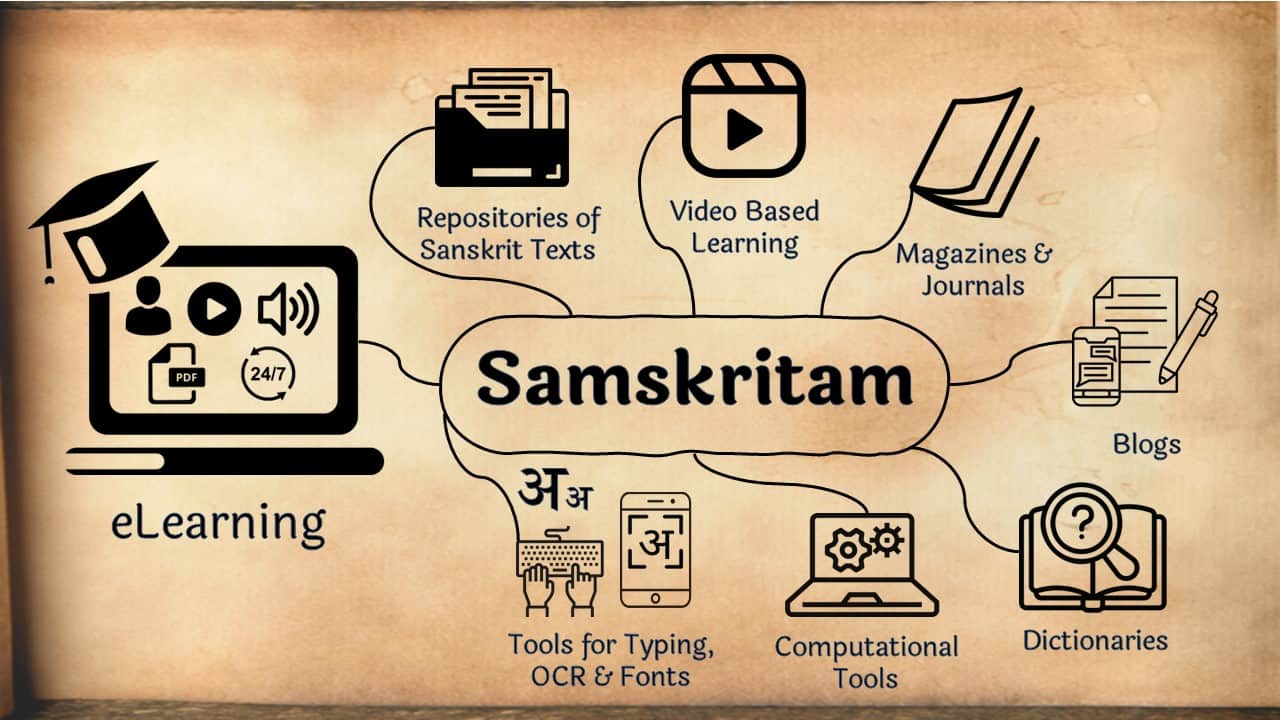
‘O-MANTRI – Online & Offline Mining of ‘Aggregated Nidhi’ for, Thematic Research in Indian-Knowledge-Systems
This is a humble attempt to compile all the IKS and Saṃskṛta related content links on the web at one place (in no particular order). This is a part of our kartavya-seva to help all the IKS and Saṃskṛta-Saṃskṛti-Saṃskāra knowledge enthusiasts. Please click on the respective tab below to view relevant details.
Note – In each domain, users are requested to first refer to the A–Series repositories for the Bhāratīya broader context, and then use the B and C-Series sources for specific, subject-focused texts.
Links are Reviewed and Updated as of Q 1, 2026
- A - Series: Universal
- B - Series: Domain Specific
- C - Series: Auxiliary Tools, Learning materials & Techniques
The A-Series brings together foundational and reference-oriented knowledge systems such as Kośa, Encyclopedic Bhāratīya Literature like Veda, Upaniṣad, Itihāsa, Purāṇa, and core repositories that are universally relevant across disciplines and domains of study.
This category includes classical kośas such as Nirukta, Amarakośa, Vacaspatyam, Śabdakalpadruma, and other dictionaries. These works are essential for understanding terminology, etymology, technical vocabulary, and conceptual precision across IKS disciplines. The websites/ portals may also contain additional resources which may be suitably utilised.
Encyclopedic Bhāratīya Literature includes the 4 Vedas, Upaniṣads, Itihāsa (Rāmāyaṇa and Mahābhārata), 18 Purāṇas, and Upa purāṇas, Darśana and Bhagavad-gītā . The websites/ portals may also contain additional resources which may be suitably utilised.
| Name | Resource Link | Description |
|---|---|---|
| Wisdom Library | https://www.wisdomlib.org/ | A large digital portal offering extensive resources on Hinduism, Buddhism, Jainism, Saṃskṛta, Ancient History, Philosophy, and related subjects, including books, articles, hymns, essays, and glossary tools — designed for research and study of Indic and world traditions. |
| Vedic Reserve — Maharishi International University | https://vedicreserve.miu.edu/ | An online collection of Vedic literature in Saṃskṛta, presented as part of the Department of Maharishi Vedic Science at Maharishi International University, aimed at promoting reading and study of classical Vedic texts. The university is a private institution founded by Maharishi Mahesh Yogi in the U.S. with a focus on consciousness-based education. |
| KSRI eBooks | https://ksri.in/ebooks/ | A large collection of ebooks and texts. |
| Vedanta Spiritual Library | https://www.celextel.org | An online Vedānta and spiritual library providing access to a wide range of texts such as the Bhagavad-gītā, Upaniṣad, Veda, Rāmāyaṇa, Vedanta literature, and spiritual works; often presented with translations or commentary. The domain is registered as a private website offering spiritual resources. |
| Sanskrit eBooks | https://www.sanskritebooks.org/ | A repository of downloadable Saṃskṛta eBooks. |
| Ashtadhyayi | https://ashtadhyayi.com/ | A website dedicated to Pāṇini’s Ashtādhyāyī — the foundational text of Saṃskṛta grammar — including Sūtrā and Dhātu (root) lists, useful for Saṃskṛta learners and scholars. |
| DharmaWiki | https://dharmawiki.org/index.php/Main_Page | A wiki-style reference platform for Indian philosophies, religions, and dharmic concepts, providing community-editable articles on a wide range of traditional topics. |
| Bharatiya Janata Party (BJP) e-Library | https://library.bjp.org/jspui/simple-search?query=Artha | A digital library / repository hosted by the BJP (Bharatiya Janata Party) featuring searchable resources, including books and documents (e.g., Artha and other Indic topics) prioritized by query. |
| Master Portal to Sanskrit links and Resources | https://sanskrit.inria.fr/ | Has more than 100 links from on various headings – updated as of 4th August 2022 |
| Register of Electronic Texts in Indian Languages | https://gretil.sub.uni-goettingen.de/ | Machine-readable texts in Indian Languages. Cumulative download and individual. download available |
| Repository of raw_etexts | https://github.com/sanskrit/raw_etexts | Veda, Purāṇa, grammar and other texts, raw form. Usable for further processing, technological dissemination. Useful for Qualitative analysis. |
| Documents, Sites, Audio, institutions (veda paatashaala), scholars etc. | https://sanskritdocuments.org/ | Provide multilanguage support. |
| https://sanskritdocuments.org/sites/ | Has learning & dictionary resources. | |
| https://sanskritdocuments.org/TextsElsewhere/ | Has processing tools. | |
| eBooks and Texts Internet Archive | https://archive.org/ https://archive.org/details/texts | Contains audio files also. |
| Wilbourhall (select Sanskrit) / Sansknet | https://www.wilbourhall.org/ https://www.wilbourhall.org/sansknet/ http://nsktu.ac.in/index.php/sansknet-3/ | Collaborative work of many organizations – large repository of Indic knowledge. |
| Central Sanskrit University | http://www.sanskrit.nic.in/ebooks.php http://www.sanskrit.nic.in/manuscript.php http://www.sanskrit.nic.in/ASSP/ http://www.sanskrit.nic.in/about_sanskrit.php | Collaborative work of many organisations – large repository of Indic knowledge. |
| Search & Retrieval of Indic texts | https://sarit.indology.info/ | 60 documents in XML. |
| Author Based Repositories | https://profbmahadevan.org/ | Prof. B. Mahadevan. |
| https://www.bhattadri.net/ | Melpathūr Narāyaṇa Bhaṭṭatiri’s full works: 1. Narāyaṇīyam 2. Śrīpāda-saptati, Prabandha, Manameyodaya, etc. |
|
| https://vidwannrs.in/ | Includes the works of Mahāmahopādhyāya Śrī Vidvān Dr. N. Ranganātha Śarma. |
|
https://sriayyaval.org/ | Śrī Śrīdhara Veṅkaṭeśa Ayyāval. |
This category includes academic journals, popular and semi-academic magazines, research articles, newsletters, and online publications. The websites/portals may also contain additional resources which may be suitably utilised.
The B-Series curates structured knowledge across specialized disciplines—ranging from philosophy, sciences, arts, governance, and health—presenting traditional and contemporary domain-specific resources in an organized manner. In this section, the enlisted 16 categories are in line with the themes published by IKS Division of Ministry of Education. The matters related to these are primarily discussed in the A – series – Bhāratīya Encylopedic Literature section.
At the multidisciplinary interface of -
[Bhāratīya] Darśanas, Upaniṣads, Prasthāna-trayī, Yoga
[HSS] Eastern & Western Philosophical Thought, Epistemology, Ontology, Philology
[STEM] Cognitive Science, Neuroscience, Psychology
| Topic | Resource link | Description |
|---|---|---|
| Yoga | https://kymyogavaisharadi.org/ | The website/portal consists of principal texts like - yogasūtrā, haṭha-yoga-pradīpikā. Then Commentaries on Yoga-sūtras like - pātañjala-yogasūtra-bhāṣya, rājamārtāṇḍa, yogamaṇiprabhā, yogasiddhāntacandrikā, sūtrārthabodhinī, yogasudhākara, yogacandrikā, yogavallī-yogasūtra-vyākhyā. It also includes sub commentaries on Vyāsa's Commentary to Yogasūtras like - tattva-vaiśāradī-ṭīkā, yogavārtika, bhāsvatī. Also includes Sub-Commentary on tattva-vaiśāradī and Commentary on haṭha-yoga-pradīpikā like pātañjala-rahasyam and jyotsnā-vyākhyā respectively. |
| https://www.wisdomlib.org/yoga https://sanskritdocuments.org/sanskrit/yoga/+C24 https://vedicreserve.miu.edu/yoga योगसूत्र | Gita Supersite https://www.vedpuran.com/listenmahakavya_patanjali.asp https://sacred-texts.com/hin/yogasutr.htm https://sacred-texts.com/hin/ysp/ https://sanskritdocuments.org/sanskrit/yoga/ https://drive.google.com/file/d/1ChAFK0ndBfUNZrmpVRSTQld_D3nhEqE3/view https://www.veducation.world/library/Vedic-Studies-%E0%A4%85%E0%A4%A8%E0%A5%8D%E0%A4%AF-%E0%A4%B5%E0%A5%87%E0%A4%A6%E0%A4%BE%E0%A4%82%E0%A4%97/yoga |
At the multidisciplinary interface of -
[Bhāratīya] Pūrva Mīmāṃsā, Saṃhitā, Brāhmaṇa, Śrauta Sūtra, Gṛhya Sūtra, Śulba Sūtra, Itihāsa, Purāṇa, Dharmaśāstra, Kāvya
[HSS] History, Archaeology, Anthropology, Manuscriptology, Epigraphy, Philology,
Geography
[STEM] Data Science, Mathematics, Computer Science
At the multidisciplinary interface of
[Bhāratīya] Pūrva Mīmāṃsā, Saṃhitā, Brāhmaṇa, Śrauta Sūtra, Gṛhya Sūtra, Śulba Sūtra, Itihāsa, Purāṇa, Dharmaśāstra, Kāvya
[HSS] History, Archaeology, Anthropology, Manuscriptology, Epigraphy, Philology,
Geography
[STEM] Data Science, Mathematics, Computer Science
At the multidisciplinary interface of -
[Bhāratīya] Jyotiṣya, Śulba Sūtra
[HSS] History of Science
[STEM] Astronomy, Algebra, Number theory, Geometry
At the multidisciplinary interface of -
[Bhāratīya] Śikṣā, Vyākaraṇa, Chandas, Nirukta, Mīmāṃsā, Mantraśāstra
[HSS] Comparative Linguistics, Lexicography
[STEM] Speech Science, Phonetics, Speech Signal Processing, Speech recognition, Natural
Language Processing
At the multidisciplinary interface of -
[Bhāratīya] Dhanurveda, Arthaśāstra, Daṇḍanīti, Rājanīti
[HSS] Political Science, Modern military history, Strategic Affairs, Economics, Public policy,
Management, Behavioural Science, Psychology
[STEM] Systems Science and Modelling, Econometry
At the multidisciplinary interface of
[Bhāratīya] Āyurveda, Yoga, Sāṅkhya
[HSS] Public Policy, Psychology
[STEM] Medicine, Physiology, Anatomy, Statistics, Life Sciences, Systems Biology, Medical Devices
At the multidisciplinary interface of -
[Bhāratīya] Pākaśāstra, Vṛkṣāyurveda, Dravyavijñāna, Āyurveda Kalā, Siddha, Folk medicine
[HSS] Home Science, Nutrition,
[STEM] Pharmacology, Botany, Zoology, Biochemistry, Systems Biology
| Topic | Resource link | Description |
|---|---|---|
| Food and Dietics (Bhojana-kutūhala, Kṣema-kutūhala) | https://ksri.in/ebooks/books/01JRA1MQCRM0WXADVTF82QJ96H |
At the multidisciplinary interface of -
[Bhāratīya] Kṛṣivijñāna, Vṛkṣāyurveda, best practices in agriculture and animal husbandry
[HSS] Public Policy
[STEM] Agriculture, Process Engineering, Botany, Zoology, Veterinary Science,
Meteorology, Climate Science
At the multidisciplinary interface of -
[Bhāratīya] Nāṭyaśāstra, Gandharva-kalā, Alaṅkāraśāstra, Sāhitya/Kāvya, Itihāsa, Purāṇa
[HSS] Musicology, Animation, Computer graphics, Cinematography, Histrionics, Aesthetics,
[STEM] Signal processing, Affective Neuroscience, Acoustics and Mechanics of instruments
At the multidisciplinary interface of -
[Bhāratīya] Yantra-kalā, Rasaśāstra, Dhātuśāstra, Vāstuśāstra, Purāṇa, Itihāsa
[HSS] History of Science, Animation, Digital design, UI design
[STEM] Mechanical Engineering and Industrial Design, Chemistry, Metallurgy, Data Science
& ML, Natural Language Processing, Computer Vision, Embedded systems,
| Note - Currently, no links are available. We welcome suggestions from users. |
At the multidisciplinary interface of -
[Bhāratīya] Vāstuśāstra, Śilpaśāstra, Tantra, Śulba Sūtra
[HSS] Archaeology
[STEM] Architecture, Conservation, Structural Engineering, Town Planning
At the multidisciplinary interface of -
[Bhāratīya] Śilpaśāstra, Alekhyādi-kalā, traditional styles across the country like Tañjāvūr, Madhubanī
[HSS] Fine arts, Sculpture, Art history
[STEM] Dyes, Organic paints, Chemistry, Dating of Art
| Note - Currently, no links are available. We welcome suggestions from users. |
At the multidisciplinary interface of -
[Bhāratīya] Rasayana sastra, Dhātuśāstra, Itihāsa, Purāṇa, Kāvya
[HSS] History, Archaeology
[STEM] Chemistry, Metallurgy, Material Science
| Topic | Resource link | Description |
|---|---|---|
| Chemistry & Metallurgy (Rāsāyanika śāstra, Loha śāstra, Dravyavijñāna) | https://www.sanskrit.nic.in/about_sanskrit.php#chemistry https://samskritifoundation.org/product/metallurgy-in-indian-through-the-ages/ https://vedicheritage.gov.in/vedic-heritage-in-present-context/metallurgy/ https://archive.org/details/uvhc_rasa-paddhati-by-shribindhu-and-loha-sarvaswam-by-sureswar-1925-bombay-vaidya-jadavji-trikamji/page/n17/mode/2up |
At the multidisciplinary interface of -
[Bhāratīya] Alaṅkāraśāstra, Alaṅkāra-kalā, Nāṭyaśāstra, Yoga, Tantra
[HSS] Fashion, Interior Design, Aesthetics
[STEM] Materials, 3d printing, Marketing, Public policy
| Note - Currently, no links are available. We welcome suggestions from users. |
At the multidisciplinary interface of -
[Bhāratīya] Krīḍā-kalā, Itihāsa, Purāṇa, Darśana, Yoga, Sāṅkhya
[HSS] Educational Science
[STEM] Game design, Toy making, Scalable manufacturing, Psychology
| Note - Currently, no links are available. We welcome suggestions from users. |
The C-Series focuses on supportive digital tools, computational resources, AI-assisted research aids, and diverse learning channels that enhance access, understanding, dissemination, and application of knowledge.
This category includes tools for Saṃskṛta typing (keyboards, transliteration editors, and input methods), OCR technologies for digitizing printed manuscripts and books, and a wide range of Unicode-compliant fonts supporting devanāgarī and other Indic scripts. The websites/portals may also contain additional resources which may be suitably utilised.
| Name | Resource Link | Description |
|---|---|---|
| Basic Digitisation Tools by System | ||
| a. Windows | https://www.pramukhime.com/windows-application https://www.azhagi.com/ https://baraha.com/main.php | Windows Indic Phonetic Keyboard (built-in Microsoft) – 10 Indian Languages. Free, simple, Unicode-compliant, available in Windows 10 & 11 |
| b. MACOS | https://github.com/daivajnanam/lipika-ime | LipikaIME - phonetic, Input Method Engine for Mac OS X, 10 Indian languages; multiple transliteration schemes supported. Built-in macOS Devanāgarī / Indic / Phonetic-QWERTY / ABC-Extended Keyboardss |
| c. Smartphones: Android & iOS | https://google-indic-keyboard.en.softonic.com/android#google_vignette | Google Indic Keyboard / Gboard – Best everyday typing, predictive |
http://idid.in/ | svaracakra (Android) – Developed by IIT-B for multiple indic scripts - | |
https://apps.apple.com/tr/app/sanskrittypist/id6450332512 | SanskritTypist (iOS) – Excellent for both Devanāgarī & IAST typing | |
| d. WEB / Browser | https://google-input-tools.updatestar.com/ https://www.google.com/inputtools/ https://www.lexilogos.com/keyboard/sanskrit.htm | >Google Input Tools - Predictive typing, hundreds of languages supported |
| e. Cross-Platform Tool for IKS Work | https://keyman.com/ | Cross-Platform: Windows • macOS • Linux • Android • iOS Multiple Keyboards: Phonetic • IAST • INSCRIPT • Custom saṃskṛta layouts Unicode Output: Works in any app — Word, PPT, Browser, InDesign Expandable: Install specialized saṃskṛta/Vedic keyboards, scripts like śāradā, grantha, etc. |
| Direct Input - Voice Typing | https://bhashini.gov.in/ | o Hindi, Tamil, Telugu, Marathi, Kannada |
| Conversion – Scripts | https://www.learnsanskrit.org/tools/sanscript/ https://aksharamukha.appspot.com/converter https://www.yesvedanta.com/keyswap/ https://anuvaad.bhashini.gov.in/ https://dharmamitra.org/ https://translate.google.com/ https://sanskrit.dev/vaani | |
| ISO – 15919 | https://www.iso.org/standard/28333.html | Covers Devanāgarī and all other Brahmi-derived Indic scripts, providing a unified Roman transliteration system. (Devanāgarī, Tamil, Telugu, Kannada, Malayalam, Bengali, Gurmukhi, Gujarati, Odia, Sinhala, Grantha, Sharda and many Himalayan and Southeast Asian scripts) Very similar to IAST. Additional special sounds like ḻ — Tamil “ழ” (zha) ṟ — Tamil “ற” |
| Conversion - Image / Pdf / Scan | https://ocr.sanskritdictionary.com/# https://www.i2ocr.com/pdf-ocr-sanskrit https://www.adobe.com/in/acrobat/online/pdf-to-jpg https://dharmamitra.org/?view=ocr https://tools.simonwillison.net/ocr?language=san https://piocr.com/ | |
| a. OCR (after setting up a Google Vision account) | https://skrutable.info/ocr | Can be used by linking to your personal Google Vision account, first 1000 pages free every month, charged after that |
https://chaya.shreevatsa.net/ | Tesseract (Free) + Google Vision (Linked to personal account) | |
| Good Fonts | ||
| a. For Devanāgarī | https://github.com/Sandhi-IITBombay/Shobhika/releases https://adishila.com/fonts/ https://sourceforge.net/projects/devanagarimpdfsiddhantafont/ https://salrc.uchicago.edu/resources/fonts/available/sanskrit/sanskrit2003.shtml https://fontreach.com/font/aparajita | |
| b. For web (drive, canva, etc) | https://www.tiro.com/fonts/tiro-devanagari-sanskrit https://fonts.google.com/specimen/Vesper+Libre https://fonts.google.com/specimen/Eczar https://fonts.google.com/noto/specimen/Noto+Serif+Devanagari | |
| c. For IAST | https://fonts.google.com/specimen/Charis+SIL https://fonts.google.com/specimen/Gentium+Plus https://fonts.google.com/noto/specimen/Noto+Sans | |
| d. Good Fonts For South Indian Scripts For IKS Work | https://fonts.google.com/noto/specimen/Noto+Sans https://fonts.adobe.com/fonts/noto-serif | Noto Sans & Noto Serif - Variants are usually compatible for cross-language, Unicode compliant IKS work across languages |
https://salrc.uchicago.edu/resources/fonts/available/tamil/latha.shtml http://typingguru.net/tamil-fonts/vijaya | Tamil - Latha and Vijaya Fonts | |
https://fonts.google.com/specimen/Baloo+Tamma+2 https://nudityping.com/nudi-fonts-download/ | Kannada - Baloo Tamma and Nudi Fonts | |
https://fonts.google.com/specimen/Mandali https://www.typingguru.net/telugu-fonts/unicode/pothana2000 | Telugu - Mandali and Pothana Fonts | |
https://fonts.google.com/specimen/Manjari https://fonts.adobe.com/fonts/rachana | Malayalam - Manjari and Rachana Fonts | |
| chandas Tools | https://www.skrutable.info/ https://sanskrit.dev/varnamala | |
| Search Engines | http://sandarbha.sangrah.org/ http://sanskrit.uohyd.ac.in:8082/searchengine/ http://www.sanskrit-linguistics.org/dcs/index.php |
This category includes tools for morphological analysis, sandhi splitting, parsing, tagging, concordance generation, text alignment, and corpus management, as well as platforms for computational linguistics, AI-based language models, and digital philology. The websites/portals may also contain additional resources which may be suitably utilised.
| Name | Resource Link | Description |
|---|---|---|
| Samsādhanī | http://sanskrit.uohyd.ac.in | This website enables one to explore Ancient Sciences and Technologies. Has many tools that provide the basic knowledge of Saṃskṛta grammar related to word formation, Sandhi, Samāsa and Kāraka. One can access the original Saṃskṛta texts with some effort. |
| Online Sanskrit tools | https://tdil-dc.in | This tool provides conversion facility among the romanised transliteration schemes into Devanāgarī and also from Devanāgarī into various romanised transliteration schemes. This site also provides tools for analysis of Sanskrit processing: morphological analysis and generation, segmentation, sandhi splitter, and parsing. |
| Saṃbhāṣā | https://sambhasha.ksu.ac.in | The primary intent of this website is to develop various computational tools for Saṃskṛta and allied languages like - Mahākośa- a kośa data navigation tool. Āyussaṃkṛtam-Courseware for Āyurvedic Medical students. Tarkasaṅgrahaḥ Ontologicalknowledge representation Vāṅmayī-e Create text – explore the meaning. Sāṅgaṇikapāli-Pali language tools Prācīnanyāyaḥ-Ontological knowledge representation Sandhi Splitting tool Bhaṭṭikāvya-nandinī-Explore Bhattikavya with Kāraka dependency diagram Vaijayantīkośa-Knowledge net Nāmadhāturūpikā-Denominative verbs Śabdakautukam-Practice noun forms Anvayacitraṇam-tool Draw relations. |
| Lexical Database | https://cfilt.iitb.ac.in | This webpage has been designed to provide a lexical database for Saṃskṛta. It is related to source materials like - Multilingual wordnets and ontologies and their linking, resolving word and attachment ambiguities, identifying correct parts of speech, named entities and non-recursive noun phrases for Marathi and Hindi, Indian language query to English and Hindi Retrieval, automatic translation involving Marathi, Hindi and English, testing if a piece text (hypothesis) is inferable from another (text), detecting polarity-positive/negative/neutral- of a given document, especially reviews, studying cognitive aspects of language processing and understanding using eye-tracking. All these are processed with help of CFILT - Computation for Indian Language Technology that primarily focuses on deep semantics and multilinguality that played a pivotal role in these activities by laying stress on semantics has led to research in the above mentioned areas. |
| The Sanskrit Heritage Site | https://sanskrit.inria.fr | The Sanskrit Heritage Site provides various services for the computational treatment for Sanskrit like – Dictionary Access (with morphology generator), a rich encyclopedic content about Bhāratīya Culture and other phonological tools like parser and so on. |
| Digital Corpus of Sanskrit | https://www.sanskrit-linguistics.org | This forum is a sandhi-spilt corpus of Saṃskṛta texts with morphological and lexical analysis. It has been designed for text historical research in Saṃskṛta linguistics and philology wherein the users can search for words and their collocations in a corpus of more than 48 lakh manually tagged words in 6 lakh plus text lines. |
| Centre of Sanskrit Studies, Jawaharlal Nehru University (JNU) | https://sanskrit.jnu.ac.in | The website hosts a wide range of tools and resources, including online lexical resources such as the Amarakośa, searchable corpora of classical texts like the Mahābhārata, Bhagavad Gītā, Āyurveda texts, Raghuvaṃśa, and selected Upaniṣads, as well as manuscript-related resources. It provides computational linguistics tools such as morphological analyzers, sandhi splitters and generators, subanta and tiṅanta analyzers, POS tagging utilities, and other Pāṇinīyan grammar–based language-processing tools. In addition, the site includes annotated corpora, research datasets, e-learning and multimedia resources, and information on ongoing research projects, workshops, and academic initiatives, making it a key platform for researchers, students, and practitioners working in Saṃskṛta studies, digital humanities, and Indic language computing. |
| The Sanskrit Library – Tools and Resources | https://www.sanskritlibrary.org | This tools page aggregates a wide range of digital resources, including text viewers, parsers, analyzers, dictionaries, corpora, and encoding standards. It supports scholarly research, teaching, and computational analysis of Saṃskṛta through standardized digital formats and open-access tools. |
| Computational Sanskrit Tools – IIT Kanpur | https://sanskrit.iitk.ac.in | This website hosts computational tools developed at IIT Kanpur for processing Saṃskṛta texts. It includes resources such as morphological analyzers, sandhi splitters, parsers, and related language-processing tools grounded in Pāṇinīyan grammar. |
| Sandarbha Sangraha | http://sandarbha.sangrah.org | It provides tools for cross-referencing, contextual lookup, and thematic navigation across classical literature. The platform is particularly useful for researchers engaged in textual analysis, intertextual studies, and traditional śāstric research supported by digital methods. |
A Structured Workflow for Research and Paper Writing
| 1. Topic Exploration & Literature Review | This stage focuses on discovering existing research, understanding the knowledge landscape, and identifying gaps. | |
| Tools & Links: | https://elicit.com/ | AI-assisted literature review tool for finding relevant papers, extracting key claims, methods, and conclusions. |
https://www.connectedpapers.com/ | Visual graph-based exploration of related research papers to understand how studies are interconnected. | |
https://www.scispace.com/ | Ask questions directly to extant literature, explore summaries, and build visual explanations from research papers. | |
https://gemini.google.com/ | Google Scholar – Citation discovery and academic reference tracking. And also useful for summarizing research articles and also extracting insights from YouTube lectures and academic videos. |
|
| 2. Knowledge Gathering from Multimedia Sources | This step integrates non-textual scholarly content such as lectures, talks, and discussions. | |
| Tools & Links: | YouTube Academic Content – Learning from lectures, workshops, and seminars. | |
| Gemini AI – Summarization and analysis of YouTube videos and transcripts. | ||
https://notebooklm.google.com/ | Analyze defined sources, generate summaries, mind maps, and audio/video overviews from curated material. | |
| 3. Data, Datasets, and Digital Resources | This stage supports empirical research, model development, and digital experimentation. | |
| Tools & Links: | https://aikosh.indiaai.gov.in/home | Repository of India-specific datasets, AI models, and digital resources for research and development. |
| 4. Analysis, Visualization & Knowledge Structuring | This step helps in interpreting data and organizing insights visually. | |
| Tools & Links: | Gemini → Google Sheets → Analysis | Workflow for tabulation, basic analytics, and trend identification. |
| NotebookLM | Concept mapping, source-grounded analysis, and structured note synthesis. | |
| Flowcharts & Graphs | Visual representation of arguments, processes, and frameworks. | |
| 5. Drafting the Research Paper | This phase focuses on converting structured knowledge into academic writing. | |
| Activities & Tools: | Draft generation using AI assistants | |
| Direct LaTeX formatting for journal-ready manuscripts | ||
| Reference Management - | ||
https://www.mendeley.com/ https://www.zotero.org/ | Multiple citation styles supported | |
| 6. Writing Support & Refinement | This stage improves clarity, coherence, and academic tone by - Expanding, shortening, and rephrasing content. Improving language flow and argument clarity | |
| Tools & Links: | https://quillbot.com/ai-content-detector | To check AI-generated content and maintain academic integrity |
| 7. Accessibility Tools (Speech & Audio) | These tools support inclusive research workflows and multilingual engagement. | |
| Tools & Links: | https://vyoma-samskritam-stt.streamlit.app/ | Speech-to-Text (STT) – Vyoma Sanskrit STT |
https://yourvoic.com/ | Text-to-Speech (TTS) – YourVoic (Sanskrit) | |
| 8. Presentation, Posters & Visual Communication | This stage focuses on disseminating research effectively. | |
| Tools & Links: | https://app.napkin.ai/ | To Create visually appealing presentations from text - |
https://www.canva.com/ | To prepare Posters, slides, infographics, and academic visuals - | |
https://www.figma.com/ | For Advanced UI/UX-based academic and research visuals - | |
| 9. AI-Based Textual Chatbots for Reference | These tools allow conversational exploration of traditional texts. | |
| Tools & Links: | https://www.yesvedanta.com/search/ https://www.yesvedanta.com/swami-paramarthananda/ https://www.yesvedanta.com/dayananda/ | vedānta-focused AI chatbot trained on svāmī Paramārthananda’s and svāmī Dayānanda's teachings. |
https://www.siva.sh/sivagpt | AI responses based on scriptural sources. | |
| 10. Ethical Awareness & Limitations of AI | This stage emphasizes responsible and critical use of AI in research. | |
| Reference Example: Misleading AI Content Case Study – | https://x.com/RapperPandit/status/1987804117910327680 | Demonstrates risks of spurious or misleading AI-generated content |
| 11. Final Communication & Dissemination | Once the research is complete, results must be communicated clearly. | |
| Activities: | Email drafting and academic correspondence. Research summaries and outreach messages. Sharing presentations, posters, and papers |
This category brings together a curated collection of online learning platforms, courses, lecture series, and self-learning resources related to Saṃskṛta and Indian Knowledge Systems beyond formal university programs. It includes video lectures, interactive learning modules, digital classrooms, and community-driven initiatives that support learners at different levels. These e-learning resources enable wider access to traditional knowledge through modern pedagogical tools, facilitating flexible, remote, and lifelong learning in Saṃskṛta and IKS. The websites/portals may also contain additional resources which may be suitably utilised.
This category focuses on video-centric educational resources that support the learning and dissemination of Saṃskṛta and Indian Knowledge Systems. It includes recorded lectures, course series, workshops, demonstrations, and explanatory videos by scholars and institutions. These resources cover language learning, Śāstric studies, philosophy, sciences, and applied disciplines, enabling visual and auditory engagement and making complex concepts accessible to a wider and diverse audience. The websites/portals may also contain additional resources which may be suitably utilised.
This category features blogs and informal online writings that engage with Saṃskṛta and Indian Knowledge Systems in an accessible and contemporary manner. The websites/portals may also contain additional resources which may be suitably utilised.
| Resource Link |
|---|
https://sanskritlinks.blogspot.com/ https://sathvishayam.wordpress.com/2018/12/10/sanskrit-links-blogspot/ https://hariprasadvarma.substack.com/ https://www.esamskriti.com/default.aspx |
This category brings together a curated set of social media channels and digital outreach platforms dedicated to the promotion, teaching, and popularization of Saṃskṛta and Indian Knowledge Systems. It includes Facebook pages, YouTube channels, and Instagram handles of various institutions.
1. Choose the appropriate script and transliteration 2. Begin with standard and authoritative websites 3. Use precise and infrequent keywords 4. Perform iterative searches 5. Combine multiple repositories for completeness 6. Verify rigorously before concluding Other general tips and tricks 1. Use the "related:" search operator to find similar websites. 2. Select the language and script strategically 3. Search basic texts (mūlam) in Devanagari 4. Search translations and explanations in English or IAST 5. Use advanced search options 6. Apply time filters to refine results 7. Combine multiple content types 8. Use exact phrases within quotation marks 9. Use plus, minus, and Boolean operators 10. Search by document type 11. Restrict searches to specific websites 12. Use an asterisk (*) for unknown words |
| Name | Resource Link | Description |
|---|---|---|
| IKS Related Articles | https://organiser.org/2026/04/26/349371/bharat/inclusion-of-indian-knowledge-systemiks-in-the-contemporary-curriculum-of-the-nation/ https://swarajyamag.com/ideas/how-ancient-india-predicted-rains-before-the-arrogance-of-modern-science | These are magazines where there are many IKS related articles. |
Note :
Any organization/individual who wants to add or delete their page/blog/link, can communicate to us, which will be done accordingly
Disclaimer:
Some of the links provided on this website direct users to external institutions or third-party websites. If any link is temporarily unavailable or not functioning as expected, we kindly request users to retry after some time. For continued issues or technical assistance, users are advised to directly contact the respective institution or website owner concerned. We appreciate your understanding and cooperation.
The information provided by Vyoma Labs is for general information purposes only. All information on this Site is provided in good faith. Vyoma Labs makes no representation or warranty of any kind, express or implied, regarding the accuracy, adequacy, validity, reliability, availability, or completeness of any information on the Site. Under no circumstance shall Vyoma Labs have any liability for any loss or damage of any kind incurred as a result of the use of the Site or reliance on any information provided on the Site.
The education information provided on this Site is for general informational and educational purposes only and is not a substitute for professional advice. This information is provided for the ease of reference of aspirants and learners, purely for academic use. The Site may have links to other websites or content belonging to or originating from third parties or links to websites and features in banners or other advertising. Such external links are not investigated, monitored, or checked for accuracy, authenticity, adequacy, validity, reliability, availability, or completeness by us.
Vyoma Labs does not warrant, endorse, guarantee, or assume responsibility for the accuracy, authenticity or reliability of any information offered by third-party websites linked through this Site or any website or feature linked in any banner or other advertising. The rights in the content provided on other websites vests with the respective rights owners. Vyoma Labs will not be a party to or in any way be responsible for monitoring any transaction between you and third-party providers of products or services.